Thursday, 23 September 2010

Oosaka is FRICKIN HUGE

Oosaka is FRICKIN’ HUGE!

Ok, so I haven’t really been up to much this past week except for hanging out with awesome people and mostly doing homework because there’s ton of the stuff! Except for that I’ve been to Oosaka (spelt Oosaka not Osaka) twice and come to the rather slow realisation that Oosaka is FRICKIN’ HUGE!

Some of you may be aware that I live in a city called Hirakata. I say it’s a city because it’s described at one (Hirakata-shi) although I think of it more as a town…or at least did. You see, from the centre of Oosaka it takes about 40mins on the fast train and an hour and a half by car (and apparently 3hours by bike). But the other day I was coming back from Oosaka and I notice that the whole way, from centre to Hirakata, there was NO breaks in the buildings. Hirakata is still part of Oosaka city and from Hirakata onwards the houses and shops just do not stop! Oosaka is HUGE! So technically I’m in the…suburbs of Oosaka.


Not only is the whole of the city huge but the centre itself. Japan has a stereotypical image of being over crowded and the most densely populated country in the world (ok that last bit isn’t a stereotype) but it really is! The shopping districts we went to were huge and there would always be people everywhere! (photo: Shinsaibashi on a busy national holiday)


Let me shed some light on this. Monday was a national holiday so I went with my speaking partner Haaki and her friend and her speaking partner to Shinsaibashi, a famous shopping arcade in Oosaka, which has all the Japanese high street stores and expensive designer clothes. It took us about 50mins to walk from one end to the other without going into any shops. It is a loooooooooong shopping arcade spread across about 5-6 blocks. Including popping into shops we were in there for a good 4 hours. (Photo: Shinsaibashi people waiting to cross the busy road that splits the long arcade)


Before during the first week I mentioned I went to Oosaka with some people from the dorm. When we arrived we took a short cut through the air conditioned mall in Namba which is connected to the train station. The underground mall (I realised today) is 9 floors and 2 basement floors and takes up the span of a block and it was still PACKED FULL with people. This Namba mall (I forget its actual name) is located at the end of Shinsaibashi right before the famous Denden town.


Denden town is the Akihabara of Oosaka. It’s famous for its electrical stuffs and manga and other geeky stuffs. This is where we went before and today we explored more of it. Denden consists of a few electrical stores and a huge arcade as it merges from Namba into Denden town and then you have the main high street which is situated on a large long road (I have yet to walk the entire length, but I wouldn’t be surprised if it were just as long as Shinsaibashi). Then you have the back streets which weave off. These are more interesting as they mainly constist of book shops, cosplay shops, maid cafes (the maids only ever give leaflets to men I noticed, and there are a LOT of men), figurine shops, card shops etc, as you head further down the main street you come across the electrical stores which specialise in TVs and rice cookers etc. (Photos: Denden town's Melonbooks. There were some better photos of what Denden's like on my previous blog)


The other part of Oosaka we explore is next to Shinsaibashi on the other side of another huge main road. This part is known as America-mura (America town) or Ame-mura for short. It mainly consists of back streets and if famous for its uniqueness, also known as the Harajuku of Oosaka. Basically it has all the alternative clothes shops such as hippie, punk, J-Rap (which is like ’chav’ fashion), and I even saw a sweet pink Lolita clothes shop. A few second hand or end of line shops with everything for 315yen! Surprisingly no gothic clothes stores and the gothic Lolita I did find was in the cosplay section ontop of Mandarake. Oh yeah, Ame-mura has Mandarake which is a pillar of geek among the alternative stuff. It’s the manga, artbooks, cards, dvds, games, cosplay, figurine store in Ame-mura: a pillar of geek among the alternative. Needless to say I got a few stuff in there and I’m glad I did because the manga and figurines are often cheaper then when you find them in Denden town!
(Photos: The Triangle park in Ame-mura and Mandarake shown by Alice (right) and Hiromi (left))


Basically to sum it up, you could be walking around Oosaka for several days before you got the centre completely scouted out, and then you have the peripheral ‘cities’ like Hirakata which have even more parts to explore! I mean, I have yet to go completely exploring around Hirakata-shi centre where the station is. And to think that you could be on a high speed train for a good hour and still not be out of the city is scary. I bet Tokyo is even bigger but it doesn’t stop Oosaka being so frickin’ huge >_<
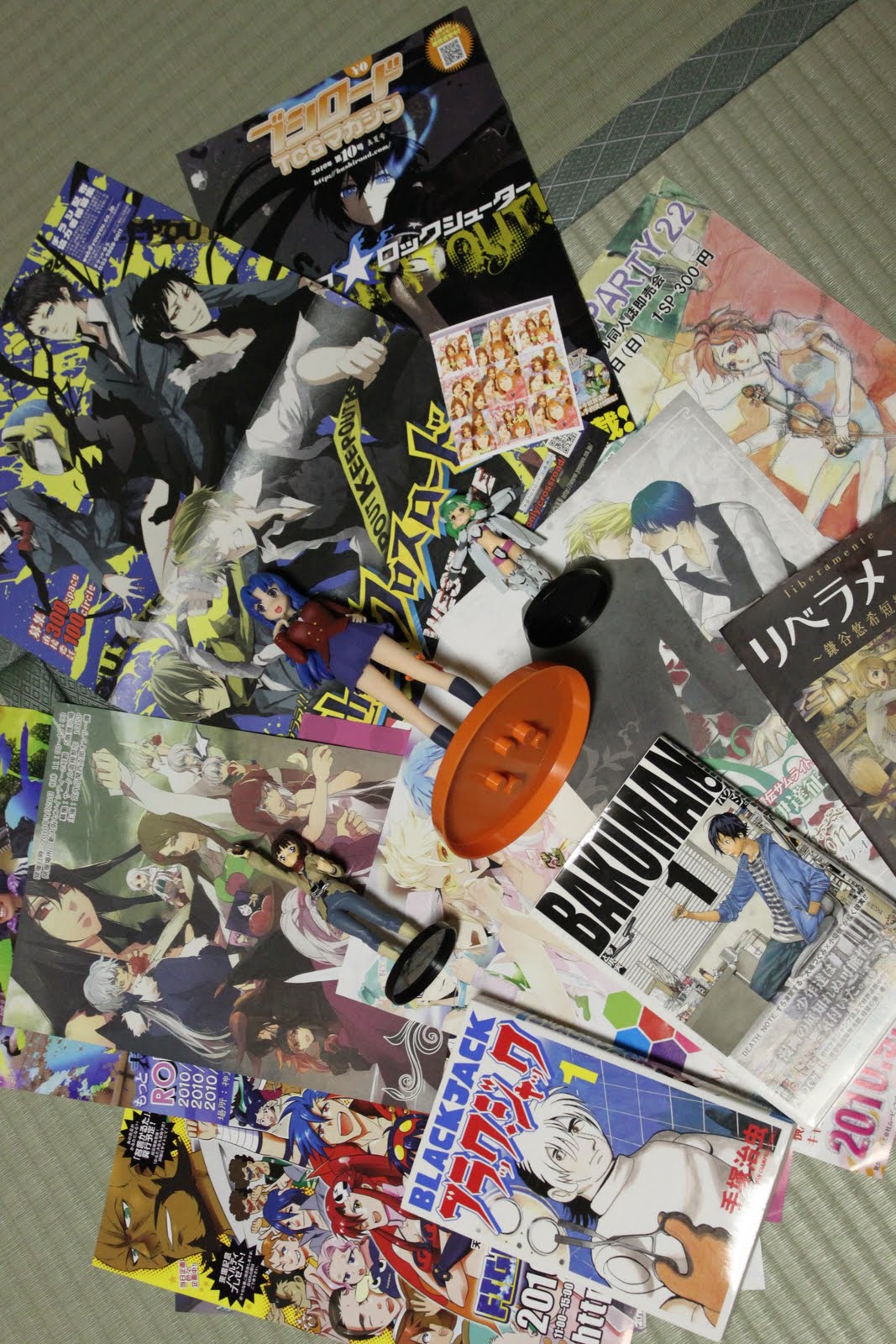


Photo: I went to Oosaka and I got a load of free shiny leaflets, some manga, some figurines and purikura. Recognise any of the stuff?


Next time on Niffer in Japan-land: "All the weird stuff I’ve found so far!"

Sunday, 19 September 2010

FAS at UKC – Living Costs in Japan

FAS at UKC – Living Costs in Japan

This is another article for the Anthropology Students at UKC because it’s been a pretty uneventful week (well uneventfulish). This is about the living costs in Japan which I can give a better estimate now that I’m out here. Before I gave tips on how the trip overall would be like and I retain the advice to SAVE NOW, even if you’re not sure you’re going to go abroad save now! And save more then you think you need, I did and I think it’s what’s saved me.

Why? Because the exchange rate’s a bitch. Thanks to the crap economy etc the £ to the yen is not as great as it was the last time I came here and instead of everything being half price it’s almost the exact price, but with basic foods costing a lot more. Sooo to sum it up I’m spending more then I thought I would thanks to the exchange rate.

Ok, let me break it down. If you want to live a pretty uneventful life doing not very much then you probably could live off of £50 a week (right now that’s about 6500yen, although could be 5000 in a few months time, who knows). If you want to go out and see sights and go shopping I suggest you budget for about £100 a week. I know you’re not necessarily going to pay this much a week (I certainly am not) but it doesn’t hurt to be safe.

I’ve found that food for cooking for about a week can be between 1500-2500yen (not including a bag of rice which can cost up to 2000yen which could last you a month) and this often lasts more then a week. Transport can be about 200yen for a bus trip (one way coz Japan don’t have return tickets), and up to 1000yen on the train (one way again), so a round trip will cost double this. Buying food out can be between 500-1000 for a single meal depending on how luxuriously you want to eat. Eating lunch at the cafeteria is about 300-700yen for a meal. I keep thinking of these as 100yen = £1 to reduce my spending. It’s working and I’ve been able to cut my spending to 300yen a day on lunch (although I keep bindging on the 100yen drinks from the machines…I need to stop doing that) and then about 2000yen a week on home cooked food (which is mainly rice, soup, veg and I had a fish the other day which was omnomnomnom).

Sooo that’s how I break my daily spending down. If I wanted to go to Osaka it would cost me 740ish there and back, plus 400 for the underground (there and back), then 700yen for a meal out, 2000yen on stuff (depending on what I’m buying…I’ll more likely spend more). Sooo that’s a total of 3800yen…ish ^_^ Which is about £30. Which if you think about it in terms of going out in England isn’t too bad, but if you want to go out every week it can build up to a lot.
So prepare prepare prepare!

Oh yeah, minor note: BANKS ARE EVIL! I went with Nationwide because before they didn’t charge for me taking money out abroad but now (again thanks to the recession) they’re going to start charging. Other banks can charge up to 5% per withdrawal (who knows how that’ll change). Oh and Nationwide, although are better then other, are being really annoying. This is my own experience and I feel like I need to rant: 2 weeks before I left the cash machine ate my flex account card (the one I use abroad) so I told the bank and they sent me a new one…the wrong one -_- I told them again and they sent a new one for the flex account…but they’d changed it so I couldn’t use it abroad. This is 2 days before I need to leave, so I call them up and they tell me they’ve upgraded my account and will sent me a new card which I can use abroad. But I’m leaving before it’ll arrive. So I leave my mum on standby to get it when it arrives and send it to me but after 3 weeks it still hasn’t arrived!! I think I could have got this sorted a lot sooner if…just stuff hadn’t kept happening that was a mixture of the bank and other stuff >_< It’s just really annoyed me and grrrrrrrr.

From this you need to realise that no matter how much you plan something will ALWAYS go wrong. *siiiigh* Ok I hope that was useful ^^; I’ll shush up now and go watch some anime to make it better (note: watch Gankutsuou)


I couldn't think of a picture to put with blog so I decided to put up a random amusing pic I found in the Osaka underground of a child getting trapped by the train doors and having fun while doing it! YAY!

Saturday, 11 September 2010

The Classes Begin

The Classes Begin

Before I began classes on the Monday I ended up giving into the temptation and blowing money on a trip to Denden town in Osaka (Saturday). Denden town is the Akihabara of Osaka, an area of Osaka that has all the figurines, manga, anime, maid cafes etc collected together into one large geeky mass. And it was pretty cool. We had cheap food, found a giant arcade where all the teenagers inside were amazing at everything they were playing (apparently the games were set at a naturally high difficulty because of the number of Otaku who go there). We went browsing and I made a note on all the shiny stuff I saw and where to get it next time. It was good ^-^

The rest of the weekend was prepping. We were finally allowed to use the kitchen so a large mass of gaijin (foreigners) descended upon the local supermarkets. Oh! That’s one thing I’ve noticed about being in Japan that I hadn’t before. Japanese people, at least in this area, are scared of foreigners. If we sit down on the bus or train some will move away (really quickly), and if we’re on the street they’ll either try to ignore us completely of give us really dirty looks. I think this is due to a combination of the fact that we’re in between two tourist dense towns with people who can’t speak Japanese or know Japanese practices so appear rude. That the previous students left us a reputation that foreign kids drink a lot and are very noisy. And that the most prominent image of foreignness in Japan are the American Army bases on Okinawa where there’s the largest crime rate and where they’re still seen as occupying Japan. It’s a bit of a shame because most of us are perfectly nice and do try to be quiet. But as our lecturers pointes out foreign people aren’t naturally quiet. That plus alcohol plus a large group = much rudeness in the eyes of Japan.

Anyway. Lessons started last week and OMG the afternoon classes in English are amazing. I’m doing Japanese and Everyday life (we get to learn anthropological field work practices and go out and interview Japanese people); Japanese Popular Culture and media (learning about manga and animes and jdrama’s influence on society); Popular Culture as social practice (learning about subcultures and my homework this week is to go to Denden town and Ame-mura in Osaka and write a 1500 report on my own fandoms). And although we have at least one article to read for each lesson (2 lessons a week which means at least 6 readings in a week) so I’ve been trying to keep ontop of those because they are really interesting and fun articles. One thing I noticed was that the anthropologicaly dense articles I’m beginning to find fun to read because I can actually understand them now!

Then there’s Japanese. We get 5 hours of speaking a week and 3 hours of reading and writing. The reading and writing teacher is really friendly although she goes through the kanji so fast and there’s lots I don’t know because I didn’t work from the genki book (last time I did was 2 years ago in Japan). Then there’s speaking…the teacher is serious and scary and intimidating >_< She really does scare the crap out of me and I want to do well but it’s hard to please someone who doesn’t smile. I think I’ll have to wait and see what happens with her. We also get homework for every Japanese lesson and then a quiz at the beginning of each week where we have to learn the vocab from the chapter of the week. Aside from lessons and mountains of homework there was also a fair amount of random happenstance this last week.

There were a few events to meet Japanese students but I also ran into a fair few just sitting down in the fish bowl (student lounge). It’s really useful talking to them although I’m still only restricted to simple statements and observations >_< I want to be able to do full blown conversations. Although on the plus side I’ve been learning Kansai-ben (the regional dialect of Japanese that young people use). For example, if you want to say ‘very’ or ‘totemo’ you say ‘mecha’. Or if you want to say a negative of something like ‘waranai’ (I don’t understand) you say ‘wakarahen’. It’s really funny trying to learn them, especially when you end up making up random sentences. What’s most interesting is that the Japanese students find it really difficult to distinguish a difference between what’s Kansai-ben and what’s normal Japanese because it’s just part of their normal language.

Ohhh yeah, one of the events that was held for the students was the Asutomo Festial. It wasn’t really a festival but a large sports day kind of thing for people to meet more people. I met a lot of Japanese again (mostly girls…actually they were all girls) and a few international students. It’s made me realise I really need to get myself a phone out here to exchange mails with people. I’ve managed to compile a long list of Japanese student’s e-mails (all girls) but I had hoped to use these contacts in the future for my research…in the mean time I’ve promised to go shopping, have lunch and to randomly talk with them. Ahhhh I don’t think I’ll have any free time to myself at this rate >_<

That’s another thing. I have noticed over this weekend that I haven’t had any time to myself! I really would like to go and find somewhere quiet today to sit down and read for hours on end. But I once again got caught up in the moment and promised a friend I’d go with her to a nearby mall this morning. Gaaaah it’s too early >_< Oh well. It shall be another fun filled day! Then tomorrow (Monday) it’s week two of lessons and homework.

Friday, 3 September 2010

First Impressions

First Impressions

It’s hard to get first impressions of a place if you’ve already been once before, but I can defiantly say the first thing I thought about Japan when I got off the plane was “Oh my god it’s hot!” Japan is in the middle of summer and in the middle of a heat wave at the moment. It’s not like the normal dry heat you rarely get in the UK (if you’re lucky). This is constant 24/7 humid sticky 35oC heat. I kid you not when I say if you decide to go to Japan in the summer take lots of tops and lots of anti-perspirant.

It was surprising how quickly I found settling in. At first I was apprehensive about the dorms because they looks so small and grey, but after meeting some of the people in the dorm it’s gotten a lot brighter. Most of the students here are either American or Australian and the topic of language has arisen a fair bit along side comments on the various accents. And although it’s only been a few days it feels like we’ve become quite good friends.

I was lucky enough to have met both my Japanese speaking partners, but my Japanese is so rusty I couldn’t get much of a conversation out of it. But I think that’s the same with most people who aren’t used to speaking the language. Like Hana, who’s also from UKC, who knows only the very, very basic Japanese. She found it hard communicating I think but we both know (and I hope her speaking partner knows) that it will get a lot easier and she starts to pick up the language and becomes more confident. I think a lot of the Japanese students here (who have yet to start class but are wandering around campus for goodness knows what) are curious about the foreigners but don’t know how to approach them (and vice-versa), unless they’re speaking partners. So I’m not surprised that I haven’t made any Japanese friends yet and I expect I shan’t make that many over the next few weeks. At least not until the Japanese student’s term starts (mid-end of September) and clubs begin and everything gets going.

I had heard that the first week would be really busy but (touch-wood) it hasn’t yet. Yes there have been lots of official things to fill in and hand it before certain dates and meetings of orientation to go to, but I’ve found myself with a lot of free time hanging around with some of the random fun people I’ve met so far. Last night, for example, some of the girls and I hung out for several hours fan-girling over anime; this afternoon we went Kareokeing for several (miserable) hours (long story); then this Saturday a load of us has planned to go to Denden town in Osaka for the day! I have no money so the plan is to make a ‘shopping list’ including costs and the shop name. In theory this could save me even more money.

…

To sum it up orientation week was a long week of exploring Hirakata city; learning how to use the transport and where to find food; meeting new people; getting official stuff sorted; having informative and inspirational assemblies (including a sex-ed one); and finishing it off with a trip to Kyoto!

Kyoto I think is what has really gotten me excited for the first time this week. It was insane the number of people going (over 400). So w had to get into a small group and was assigned a few Japanese students to take us on the train to Kyoto. We could choose where we wanted to go and almost everyone chose the temples and so was taken to Kiyomizu-dera (tera/dera= temple). We were happy to wander around in our small group acting like gaijin (foreigners) and practicing the Japanese Shinto customs. We got fortunes and I got a ‘middle luc’ fortune (not as bad as Abby who got the worst luck-she tied it to a tree to stop the bad luck happening). Then we went to an area famous for it’s god which is often affiliated with love. There are two rocks which they say if you can go from one rock to the other with your eyes closed your love will come soon, If you can’t do it then you will have to wait, and if you get help finding your way then you will need help to find your love. I tried it, but one of the guys decided to distract me and clapped his hands when I was about 1m away! So I opened my eyes.

But it was still soooo hot and we were all sweating a disgusting amount. I think we were all happy when evening started to set in and we wandered down into the town as the sunset. Through the back-streets of Kyoto is a very different sight to the main streets.


The main-streets were the most striking when I got off the train, I didn’t think it was even Kyoto. It looked just the same as the other modern-ish grey hot sticky towns we’ve passed through. But as we ventured up to the temple, and especially wandered back down through the back-streets, you could see the older traditional houses with their beautiful small wooden frames and slanted slate roofs. As we ventured through another jinjya (shrine) where lanterns with company names who had donated money to the shrine hung all around the centre; the city centre opened out to us and the busy night-life of Kyoto emerged. A quick detour from the main street took us onto Gion, the part of the city famous for it’s geisha, and we saw some! My camera was on the wrong setting so the first blurred, but I managed to find a second and got a shot of her. They look very serious and I feel a bit rude taking pictures of them, but I know I would have regretted not taking one.

After wandering back out onto the high street we passed a beautiful kabuki theatre which was apparently going to close soon because not enough people go to see kabuki! A real shame. I guess people prefer entertainment more like the street we wandered down which my friend referred to as the “glamorous red-light district”. This was a road full of bars for men to pay and sit with girls and buy them drinks. We even passed an infamous love hotel. One of our Japanese guides said he’d stayed in one but only because it was cheap accommodation, especially if you’re with a few people…I think I’ll take his word for it. I don’t plan to find out at all really XD At the end of that road was a small gyudon restaurant. Here you bought a ticket for food out of a machine and gave the ticket to the chef who stands in the small kitchen behind the counter. Gyudon is rice with meat and egg ontop, it also came with a raw egg which you whisked and poured on, and miso-shi (soup) of course, but that was eaten separately. I was sooo hungry I ate Hana’s miso-shi too.

The point of the Kyoto trip was to meet new people and work out the train system. I don’t think we really did until both our guides had gone home and we decided to take a short-cut back by taking another train. Working out the train routes and times was a lot easier to work out on our own surprisingly, because we weren’t shown by the Japanese students how to read a map, only how to get a ticket. And although we got slightly lost in Hirakata-shi (city) we made it back eventually and now I feel ready to zonk out and not wake up for a good 10 hours. Oyasumi!

Wednesday, 18 August 2010

FAS at UKC – Japan Universities

For Anthropology Students at UKC
First of all I’m going to point out the pros and cons of going to Japan, not matter what University you choose:
Pros:
-Learn Japanese quickly
-Meet lots of interesting people from around the world
-Experience something new
-Get a good grade towards your degree (it is apparently quite easy to get a 1st abroad as long as you work hard)
Cons:
-Away from home for just under a year
-Added cost to loan at end of degree (but I’d say it’s worth the experience –you only live once)

You have a choice out of three universities in Japan on the Anthropology degree. These are APU in Beppu, Kansai Gaidai near Osaka, and Waseda in Tokyo. Each has their pros and cons and the choice depends on you and what sort of person you are and what you want out of the year abroad. I’m going to Kansai Gaidai and so I know the most about it. If you are thinking of choosing one of the others and have questions then I suggest e-mailing the other students who are going/have been to those ones.
In all the Universities you study Japanese Language and sociological/anthropological modules based on East Asia, although I think in some cases you have the option to choose modules in business and religion.


http://www.apu.ac.jp/academic/
Reitsumeikan Asia Pacific University (APU) in Beppu is the default choice and every Anthropology student is confirmed a place here. It is located on top of a mountain overlooking the town and the sea. Beppu is located in the south of Japan in Kyuushuu. It is a very beautiful area and I was lucky enough to visit it for a week during my gap-year. The town itself has a lot of international students, mostly Chinese and Korean. It has all the shops you could need and some really nice tourist spots like the 9 Hells (which are coloured onsen) and just normal onsen you really do need to try out, then there’s THE MOST amazing aquarium ever. To be honest the web-page is not very useful but I do know that many people who have gone in the past have loved it. The University provides accommodation that’s 446,750 yen for the year that’s on campus. You choose your modules when you apply and there are clubs and societies to meet people.
Pros:
-A guaranteed place at the university
-Access to interesting countryside and areas people don’t normally visit
-Lots of interesting places inside Beppu
Cons:
-Far from any main tourist areas
-The University is situated out of the town so a bus is needed to get in


http://www.kansaigaidai.ac.jp/asp/no_intro_index.html
Kansai Gaidai in Hirakata is located along the main line between Kyoto and Osaka. This means the area is rural but it’s easy to get into the larger city and tourist areas. The University itself provides a wide range of modules with compulsory Japanese (all of which can be seen on the website). You choose your modules in Japan although it’s good idea to look them over beforehand. Accommodation is provided although you do have to stay in a room with another person (you can request who you stay with or whether you want to be with a Japanese student or not). Each accommodation has shared kitchens and bathrooms and living space (a good opportunity to meet other international students). The accommodation price is fair at 200,000 yen for each semester (or 400,000yen for a year which is about £3000) in the cheaper dormitories. Or you can stay in home stay with a Japanese family (320,000yen per semester), something I strongly suggest you try out, possibly in the second semester when your Japanese is more confident. Most of the international students are American as it’s a foreign languages University (so the Japanese students are normally learning a foreign language just as the foreign students are learning Japanese). There are also a lot of clubs/societies which you only choose one of but it’s a good way to meet people with similar interests. The University also provides a Japanese partner program and an option to visit Japanese families at the weekend (this may also be available in other Universities). One thing though, there are normally only 2 places available at Kansai for Kent students (3 at a push)
Pros:
-Easy access to Osaka and Kyoto
-Wide range of modules and societies
-Reasonably priced accommodation
-Japanese partner/family program
Cons:
-Shared rooms in accommodation
-Only 2-3 spaces for UKC students


http://www.waseda.jp/top/index-e.html
Wadeda University in Shinjuku, Tokyo, is in the centre of one of the largest, busiest metropolises in the world. Not only that but it is considered to be the second most prestigious university in Japan, it’s like going to Cambridge. This means the work and students are a bit more serious then at the other universities. I e-mailed a student who went last year and she said:

“Out of 50,000 only about 2,000 is foreign but you do not really see it as most of them are Chinese and Korean. Waseda also has several campuses and I am staying in one of them. Most of the foreign students seem to stay at home stay though. In my campus all rooms are single with a separate male and female bathroom/shower in the corridor. A kitchen is shared by about 15 people but we all have a fridge in our rooms.
Waseda area is in between two bigger centers i.e. Ikebukuro and Shinjuku. Closest tube stations are within 5 min walk and a train station about 15 min. In addition buses are available. Several grocery stores, restaurants, cafes are located around the campus and just outside it. The student union has a coop bookstore and a grocery store as well. Japan Anthropology has been a great module. There a several other you can choose from regarding gender studies, religions, urban studies, politics, etc.
They take Japanese studies more seriously than Ritsumeikan or the one in Osaka. We have nine hours of Japanese each week plus loads of homework. Even if you have never studied any Japanese before you have to study nine hours each week. They are more strict about attendance as well and you can miss only 30% of your classes. The normal length of a class is also longer i.e. 90 min.”

Pros:
-Prestigious university
-Centre of Tokyo
-Home stay available
-Lots of Japanese students
-Individual rooms in accommodation
Cons:
-Expensive accommodation
-Stricter classes
-Only 1 space for UKC students

Thursday, 5 August 2010

FAS at UKC –Costs of Japan

For Anthropology Students at the University of Kent in Canterbury

One of the biggest worries and one of the biggest reasons people dropped out of the Japan program in my year, was money issues. It’s the one problem everyone faces and needs to know a lot of information on, but unfortunately, it’s the least informed subject. When I joined Social Anthropology with a year in Japan at UKC there were 20 other students joined up, and now there are only 6 going. Ok, so money wasn’t the only issue, each person had their own reasons for dropping out, but this one was a huge factor in many of them, and hopefully what I’m about to say will help.

Ok, so you’re planning to study for a year abroad. Holy crap where do you start!? How much will you need to survive on your own in a place far away from your family!? Well one thing I think is that it’s just like going to University normally…only it’s on the other side of the world instead of about 100miles away. Well, when I say it’s just like going to University normally, I’m referring to the costs. People say “Ahhh Japan is so expensive to live in!” And yes it is, but only if you’re going to Tokyo. Going to Tokyo is like going to London, it is expensive. But move out of the capital and the prices are very reasonable. University accommodation is roughly 400,000 yen for the year, at the current exchange rate that’s about £3000, which is roughly the same cost as a year in Parkwood houses, or a shared house in Canterbury (possibly even cheaper). Do you want to know the best thing about it? Your maintenance loan will cover the cost! \o/ Or at least it should do (did mine). When it comes to actually getting round to paying your 400,000-odd-yen for the year, your University in Japan will tell you more information on how to do it when you’ve been accepted (which is really early on in the year).

Second scary costs: Flights! People tell me “London to Tokyo flights are the most expensive in the world, they must be at least £1000!” Wrong! Well actually they’re right, but you’re not going to be flying to Tokyo (unless you go to Waseda –I’ll explain more on that another time). I got an open return ticket to Kansai International airport in Osaka for £731 with Emirates (and airline I strongly suggest for its 30kg luggage weight limit –most are 20kgg and not enough for a years worth of luggage). A friend of mine who IS going to Tokyo got hers for around £500, but that was with Ryan air I think (one I suggest not getting –you get what you pay for). Another great thing about this is that your maintenance loan will cover the cost for your flights as well! This is because at UKC because you are studying abroad you only pay HALF the normal tuition fee, so the other half of money that the loans company would put towards tuition, goes onto your maintenance. That’s roughly £1600 to UKC and about £4300 to you to cover accommodation and flights! One note: the only money that goes to the Japanese university is accommodation. You DO NOT pay the Japanese University’s tuition fee (which can be a lot). This is because UKC and the Japanese University’s have set up something so we just say UKC. Win!

The third big scary cost is basic living. Now, with exchange rates changing ALL the time it’s hard to say exactly the costs, but I think of it as being the same as it is living at University in England. Food is cheap if you buy it and cook it yourself, but expensive if you go out every night, and the prices in Japan and England for food are roughly the same (possibly even cheaper in Japan). Travel will be the highest cost, especially if you want to visit the local sights, but it really does depend on where you go. I think I will give a better update on the day to day costs when I get out there and have a better picture of what it’s like. At the moment I’m putting aside £200 a month for basic living and transport costs.

The holidays are the best time to travel and see Japan, but can be the most costly. This is what you want to save up extra for (besides basic food). A bus across Japan can be ridiculously cheap (cheaper then England ie £30 for a bus from Osaka to Tokyo), or you can get the Shinkansen (bullet train) for £100 from Osaka to Tokyo, or fly which would be £150 from Osaka to Tokyo. In Japan it really is a case of you get what you pay for. Accommodation is the most difficult to work out because, like anywhere, there are always places trying to rip-off the foreigners. Do your research!!! I did and found Sakura House, accommodation in Tokyo which accommodates for foreigners only with rented apartments for £300 a month (instead of £600 which cheap hotels would charge). This sort of deal is perfect for staying in Tokyo for a long period (I think they also do a few weeks). Extra travel costs really do depend on where you’re staying and what you want to do. Have a rough idea and start searching early so you can get an idea for what you want to do. What I’ve planned for is roughly an extra £1000 for each month I want to travel.

Now you’re thinking “how am I going to get all the money for this!?” (because I did). I have two key suggestions. SAVE NOW! I started saving from the point I started university. If you’re lucky like me and get money from your parents to cover living costs then put a little aside each week and try really hard not to spend the little you put away. I did and managed to save £2500 in the first 2 years at Uni. Also, get a summer job! It’s worth putting the experience on your CV at later life and you can get an extra £1000 or so per job. I strongly suggest not getting a job during term time unless you can handle it, because it is important to do well at your degree so you can go to Japan. That includes learning the language before hand, which is another thing people had problems with. I’ll go onto the language issues before you leave another time.

If you have any questions on stuff I might not have covered then feel free to message me ^^
-Niffer